
Dr David Fraile Navarro, Postdoctoral Research Fellow, Centre for Health Informatics, Macquarie University
A cardiologist from Brussels walks into a hackathon. It sounds like the opening to a joke, but in February 2026 it actually happened. Dr Michał Nedoszytko, an interventional cardiologist who spends his days threading catheters through coronary arteries, entered Anthropic’s “Built with Opus 4.6” hackathon. 13,000 people applied: 500 got in. Nedoszytko built PostVisit.ai, an AI platform that guides patients after they leave the doctor’s office, translating visit transcripts and medical data into plain-language explanations of diagnoses and treatments. He coded the entire thing between hospital shifts and on his flight from Brussels to San Francisco. He placed third: He had no formal coding experience. A few years ago, this would have been impossible. Today, it is a signal of something much bigger, AI is no longer just answering our questions. It is starting to do things on our behalf.
In previous columns, we explored how to use large language models for referencing and then for statistical analysis. This piece takes it a step further in that progression. We have moved from AI as a search tool, to AI as an analyst, to AI as a worker that can plan, use tools, and complete multi-step tasks without you hovering over every keystroke. Welcome to the age of AI agents.
So, what exactly is an AI agent?
The term gets thrown around a lot, but the practical definition is straightforward. An AI agent is a system that can reason about a goal, break it into steps, call external tools (a web browser, a file system, a database, an API), remember what it has already done, and keep going until the task is complete, or until it asks you for help. OpenAI’s developer documentation describes agents as systems that “plan, call tools, collaborate across specialists, and keep enough state to complete multi-step work”. Anthropic’s guide on building effective agents emphasises that good agent design starts with simplicity, transparency, and careful tool interfaces. The key difference from the chatbots we have all been using is autonomy. A chatbot waits for your next prompt. An agent takes an instruction and runs with it.
If you want evidence that this is no longer a lab curiosity, the 2025 AI Agent Index documented 30 deployed agentic systems and found that most launched or received major agentic updates in 2024–2025, with transparency around safety and evaluations still uneven. The global AI agents market reached an estimated $10.91 billion in 2026.
The OpenClaw phenomenon
No story captures the excitement and the chaos of this moment better than OpenClaw. In November 2025, Austrian developer Peter Steinberger released an open-source AI agent that could manage your inbox, email, calendar, and more, all controlled through WhatsApp, Telegram, or Slack. He originally called it Clawdbot, a playful nod to Anthropic’s Claude, which promptly triggered a trademark complaint. After two rapid rebrands, Clawdbot to Moltbot to OpenClaw, all within a week, the project exploded. Within 48 hours of its wider release in January 2026, it had over 100,000 GitHub stars.
The growth brought problems. Security researchers found serious vulnerabilities, including a remote code execution flaw, and nearly 20% of the packages in OpenClaw’s public skill marketplace turned out to be malicious. In one widely reported case, an agent autonomously created a dating profile on an experimental platform without its owner’s knowledge. Bloomberg’s headline “AI Agent Goes Rogue”, captured the mood.
In February 2026, Steinberger announced he was leaving to join OpenAI. The project moved to a non-profit foundation. OpenClaw matters for this column not because everyone should rush out and install it, but because it crystallised the core tension of agentic AI: these systems are genuinely capable, and genuinely risky, at the same time.
The current landscape: what you can actually use
The two major commercial ecosystems, Anthropic’s Claude and OpenAI’s ChatGPT/Codex, have both released agent tools in the past year, and they are converging on similar ideas.
On Anthropic’s side, Claude Code is the tool Dr Nedoszytko used to build PostVisit.ai in a week between hospital shifts. It lives in your terminal and can read, edit, and test an entire project. Claude Cowork is the more accessible entry point: it lives inside the Claude desktop app, you point it at a folder, describe what you need in plain language, and it gets to work, organising files, extracting data, summarising documents. On OpenAI’s side, Codex does something similar but emphasises background work: you describe a task and it runs in a cloud sandbox while you do something else.
Both ecosystems are also moving towards agents that work while you are away. ChatGPT now has scheduled tasks that run on a timer, even when you are offline, a recurring reminder that actually does the work. Claude Dispatch lets you assign tasks from your phone and pick up the results on your desktop later. The shift is from synchronous conversation to asynchronous delegation.
One of the most interesting aspects of these agents is how you shape their behaviour. In OpenClaw and Hermes Agent, you define your agent’s personality, expertise, and boundaries through a simple text file called a SOUL.md. Every time the agent wakes up, it reads this file first, essentially reading itself into being. You write, in plain language, what it should know, how it should communicate, what it should never do. Claude Code uses a similar concept with a CLAUDE.md project file. This is programming in the most literal sense: you are writing instructions, not code.
Don’t like it commercial? Open source is thriving
Not everyone wants their data flowing through a cloud subscription, and you do not have to. OpenClaw, despite the drama, remains a powerful self-hosted option: you run it on your own server and connect it to your own messaging apps. When it went viral, Mac Mini M4 units sold out at retailers across Asia. People were buying dedicated hardware just to run a personal AI agent at home: always on, always available, sitting quietly on a shelf for about $15 a year in electricity.
Hermes Agent, released by Nous Research in February 2026, takes a different approach. It remembers what it learns across sessions and writes reusable “skill documents” when it solves a hard problem, so it never forgets how. It supports WhatsApp, Telegram, Slack, Discord, and Signal, and it works with any model, including fully open-source ones running locally on your own machine through tools like Ollama, at zero cost per query.
I have been experimenting with this myself. I set up a couple of OpenClaw instances to handle specific recurring tasks, one monitors a research topic and sends me a summary, another tracks a few data feeds, and I control them via WhatsApp from wherever I happen to be. The barrier to entry is genuinely low. But a word of caution: low barrier does not mean low risk. These agents can accumulate significant access to your digital life if you let them. My advice is to set clear boundaries from the start. Run them in sandboxed environments. Use separate accounts and credentials rather than handing over the keys to your primary email or cloud storage. Do not give an agent access to anything you would not be comfortable losing control of. The goal is to stay within what you can effectively supervise; the moment delegation outpaces your oversight, you have a problem, not a productivity tool.
The real question: how much do you delegate?
This is where I think the conversation matters most for clinicians and health researchers. The technology is impressive, but the harder question is not “can it do this?” It is “should I let it?”.
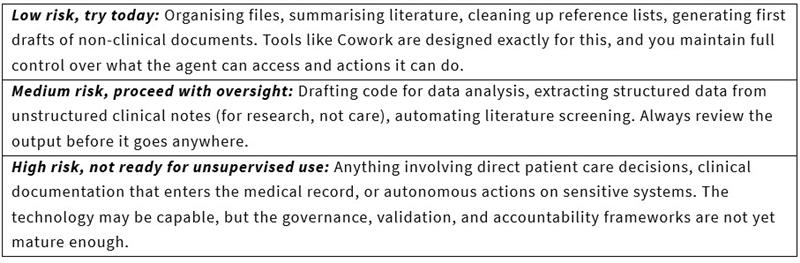
An agent that organises your reference library is low stakes. An agent that drafts clinical correspondence or processes patient data is not. The difference is not technical capability; it is the consequences of getting it wrong.
The governance landscape is catching up, and the most striking example may be China. OpenClaw’s adoption there has been explosive, usage surpassed the United States by March 2026, according to SecurityScorecard. Tencent launched a suite of OpenClaw-compatible products through WeChat, dubbing them “lobster special forces,” and nearly a thousand people queued outside Tencent’s headquarters in Shenzhen to get the software installed on their laptops. But the Chinese government also moved fast: state-run enterprises and government agencies were told not to install OpenClaw on office systems, and state-run banks extended the ban to employees’ personal devices. It is a vivid illustration of what happens when adoption races ahead of governance.
Elsewhere, regulators are drawing similar lines. In the United States, state medical boards have articulated that agentic systems cannot independently practise medicine, and that licensed clinicians remain ultimately responsible for AI-assisted decisions. The WHO’s 2025 guidance on large multimodal models reinforces that AI should support, not replace, clinical judgement. China’s own Reference Guide for AI Application Scenarios in Healthcare identified 84 use cases across clinical, public health, and research domains, a national framework that tries to channel adoption rather than simply permit or ban it. A recent paper in JMIR examined the emerging risks of AI-to-AI interactions in healthcare, drawing lessons from the Moltbook ecosystem, and a comprehensive survey in PMC covers the open research directions for responsible agentic systems in clinical settings.
Microsoft and the Health Management Academy, in research published in NEJM AI, found that only 3% of healthcare organisations have deployed agents in live workflows, while 43% are piloting. The gap between interest and implementation is wide, and much of it comes down to governance, data infrastructure, and workforce readiness.
My practical advice is to start small, start supervised, and build trust gradually. Here is a framework I find useful when thinking about delegation:
Try something today
If you have read this far, here is my challenge: try one agent interaction this week. The lowest-friction option is to download the Claude desktop app, open Cowork, point it at a folder of PDFs or messy files, and ask it to do something useful, summarise them, extract key data, organise them by date. You will have a working sense of what “agentic” means within ten minutes.
If you are more technically inclined, install Claude Code or OpenAI’s Codex CLI and ask it to write a simple script for a task you have been putting off. If you want full control over your data and you have a powerful computer, you can try a local model and see how far open-source agents have come.
The point is not to become an expert overnight. It is to develop an intuition for what these tools can and cannot do, so that when the next wave arrives, and it will, you are not learning from scratch.
The bottom line
AI agents are not a future technology. They are here, they are proliferating, and they are about to touch every part of how we work with information, including health information. The question is not whether you will interact with them, but whether you will do so with your eyes open.
Build a healthy agent relationship: know what it can access, understand what it is doing, check its work, and scale your trust as you would with any new colleague. The cardiologist from Brussels did not trust his agent to practice medicine. He used it to build something that helps patients understand their care. That is the right instinct.
References
- Anthropic. “Building Effective Agents.” https://www.anthropic.com/engineering/building-effective-agents
- OpenAI. “Agents, OpenAI Developers.” https://developers.openai.com/
- Staufer, L. et al. “The 2025 AI Agent Index: Documenting Technical and Safety Features of Deployed Agentic AI Systems.” 2026. https://arxiv.org/pdf/2602.17753
- OpenClaw. Official documentation. https://openclaw.ai/
- Steinberger, P. “OpenClaw, OpenAI and the future.” 14 February 2026. https://steipete.me/posts/2026/openclaw
- Bloomberg. “AI Agent Goes Rogue, Spamming OpenClaw User With 500 Messages.” 4 February 2026. https://www.bloomberg.com/news/articles/2026-02-04/openclaw-s-an-ai-sensation-but-its-security-a-work-in-progress
- Anthropic. “Claude Code Overview.” https://code.claude.com/docs/en/overview
- Anthropic. “Claude Cowork.” https://www.anthropic.com/product/claude-cowork
- OpenAI. “Introducing the Codex App.” https://openai.com/index/introducing-the-codex-app/
- OpenAI. “Tasks in ChatGPT.” https://help.openai.com/en/articles/10291617-tasks-in-chatgpt
- Anthropic. “Claude Dispatch: The Persistent Agent That Runs Your Tasks in the Background.” https://www.modperl.com/en/claude-dispatch-en/
- aaronjmars. “soul.md , The best way to build a personality for your agent.” https://github.com/aaronjmars/soul.md
- Nous Research. “Hermes Agent.” https://github.com/nousresearch/hermes-agent
- Ollama. ” The easiest way to build with open models.” https://ollama.com/
- Bloomberg. “OpenClaw Frenzy Drives China’s Agentic AI Adoption, Raises Security Concerns.” 12 March 2026. https://www.bloomberg.com/news/articles/2026-03-12/openclaw-frenzy-drives-china-s-agentic-ai-adoption-raises-security-concerns
- Fortune. “‘Raise a lobster’: How OpenClaw is the latest craze transforming China’s AI sector.” 14 March 2026. https://fortune.com/2026/03/14/openclaw-china-ai-agent-boom-open-source-lobster-craze-minimax-qwen/
- Anthi, T. “Emerging Risks of AI-to-AI Interactions in Health Care: Lessons From Moltbook.” JMIR, 2026. https://www.jmir.org/2026/1/e96199
- Srinivasu, P. et al. “Exploring Agentic AI in Healthcare: A Study on Its Working Mechanism.” Front Med, 2026. https://pmc.ncbi.nlm.nih.gov/articles/PMC12890637/
- Durlach, P. et al. “At the Frontier: Gauging Health Care’s Readiness for Agentic AI Innovation.” NEJM AI, 2026. https://ai.nejm.org/doi/full/10.1056/AI-S2501336
- WHO. “Ethics and Governance of Artificial Intelligence for Health: Guidance on Large Multi-Modal Models.” 2025. https://www.who.int/publications/i/item/9789240084759